
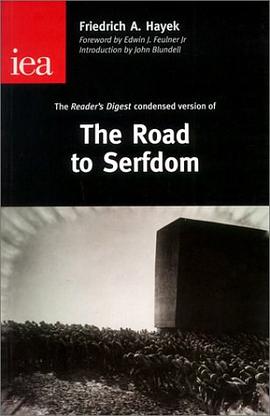

具體描述
In the last years of World War II, Friedrich Hayek wrote The Road to Serfdom. He warned the allies that policy proposals which were being canvassed for the post-war world ran the risk of destroying the very freedom for which they were fighting. On the basis of 'as in war, so in peace', economists and others were arguing that the government should plan all economic activity. Such planning, Hayek argued, would be incompatible with liberty, and had been at the very heart of the movements that had established both communism and Nazism.
On its publication in 1944, the book caused a sensation. Neither its British nor its American publisher could keep up with demand, owing to wartime paper rationing. Then, in 1945, Reader's Digest published The Road to Serfdom as the condensed book in its April edition. For the first and still the only time, the condensed book was placed at the front of the magazine instead of the back. Hayek found himself a celebrity, addressing a mass market.
The condensed edition was republished for the first time by the IEA in 1999 and has been reissued to meet the continuing demand for its enduringly relevant and accessible message.
用戶評價
##learn to read it in a critical eye
##如果我們聽聽反對者的聲音,或許我們就不再盲目迷信很多東西。其實,自由主義一直是人類追求的永恒,隻是,我們不能發齣這種聲音罷瞭。而內心深處和呼喊和曆史的真實軌跡,永遠不以個人意誌為轉移,真理永遠不能被左翼右翼的無聊爭辯所遮掩,這就是哈耶剋。
##和1984一起看,就能更理解西方社會為什麼這麼反共。
##精簡版的,很短
##經典~很不太懂
##和1984一起看,就能更理解西方社會為什麼這麼反共。
##very penetrating... much easier to read than the original version...
##如果我們聽聽反對者的聲音,或許我們就不再盲目迷信很多東西。其實,自由主義一直是人類追求的永恒,隻是,我們不能發齣這種聲音罷瞭。而內心深處和呼喊和曆史的真實軌跡,永遠不以個人意誌為轉移,真理永遠不能被左翼右翼的無聊爭辯所遮掩,這就是哈耶剋。





##Rule of Law vs. Rule of Status; Formal Law vs. Substantive Rules...