

具体描述
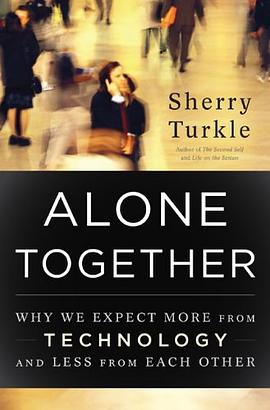
Consider Facebookit’s human contact, only easier to engage with and easier to avoid. Developing technology promises closeness. Sometimes it delivers, but much of our modern life leaves us less connected with people and more connected to simulations of them. In Alone Together , MIT technology and society professor Sherry Turkle explores the power of our new tools and toys to dramatically alter our social lives. It’s a nuanced exploration of what we are looking forand sacrificingin a world of electronic companions and social networking tools, and an argument that, despite the hand-waving of today’s self-described prophets of the future, it will be the next generation who will chart the path between isolation and connectivity.
用户评价
##A great book, makes you think! See the need, explore the market, and produce the products. But it is not about what the technology do for us, it is about what the technology do to us.
##that's why i dislike sociology...tons of redundant self-justifications...it's undeniable that these problems exist but the way sociologists address them only makes them all the more complicated and confusing...
不管是多好的书,变成作业就很头疼
##昨晚正好看了机械姬。。。感觉就是psychopath的变种啊,书主要观点还是人找机器人做伴侣是因为they'd rather live disappointed than to be disappointed. 没挑战那多没意思嘛
##名字很文艺,内容很学术。
##1. AIBO一类都还不算AI的robot毕竟只是addition而不是substitution的存在。2. Turkle延续了几年前的思路,试图从relational artifact的角度而不是intrinsic property的角度来思考科技or even AI。那么问题来了,如此distinction真的站得住脚么?Turkle对relational artifact的担忧恰恰是来自于科技某些intrinsic property的缺失。
##Demonstrates people's vulnerability when always connected. Inspiring.
##三部曲中的第三部。。。our networked life allows us to hide from each other...we'd rather text than talk...











##三部曲中的第三部。。。our networked life allows us to hide from each other...we'd rather text than talk...