

Chapter 1. The Breadth and Depth of DSP
Chapter 2. Statistics, Probability and Noise
Chapter 3. ADC and DAC
Chapter 4. DSP Software
FUNDAMENTALS
Chapter 5. Linear Systems
Chapter 6. Convolution
Chapter 7. Properties of Convolution
Chapter 8. The Discrete Fourier Transform
Chapter 9. Applications of the DFT
Chapter 10. Fourier Transform Properties
Chapter 11. Fourier Transform Pairs
Chapter 12. The Fast Fourier Transform
Chapter 13. Continuous Signal Processing
DIGITAL FILTERS
Chapter 14. Introduction to Digital Filters
Chapter 15. Moving Average Filters
Chapter 16. Windowed-Sinc Filters
Chapter 17. Custom Filters
Chapter 18. FFT Convolution
Chapter 19. Recursive Filters
Chapter 20. Chebyshev Filters
Chapter 21. Filter Comparison
APPLICATIONS
Chapter 22. Audio Processing
Chapter 23. Image Formation and Display
Chapter 24. Linear Image Processing
Chapter 25. Special Imaging Techniques
Chapter 26. Neural Networks (and more!)
Chapter 27. Data Compression
Chapter 28. Digital Signal Processors
Chapter 29. Getting Started with DSPs
COMPLEX TECHNIQUES
Chapter 30. Complex Numbers
Chapter 31. The Complex Fourier Transform
Chapter 32. The Laplace Transform
Chapter 33. The z-Transform
Glossary
Index
· · · · · · (收起)
具體描述
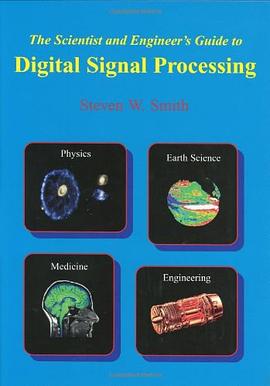
This book was written for scientists and engineers in a wide variety of fields: physics, bioengineering, geology, oceanography, mechani cal and electrical engineering, to name just a few. The goal is to present practical techniques while avoiding the barriers of detailed mathematics and abstract theory. To achieve this goal, three strategies were employed in writing this book:
First, the techniques are explained, not simply proven to be true through mathematical derivations.
Second, complex numbers are treated as an advanced topic, something to be learned after the fimdamental principles are understood.
Third, very simple computerprograms are used.
This book was also written with the practicing professional in mind. Many everyday DSP applications are discussed: digital filters, neural networks, data compression, audio and image processing, etc. As much as possible, these chapters stand on their own, not requiring the reader to review the entire book to solve a specific problem.
You can browse and/or download the entire book without charge on the book site: http://dspguide.com/
用戶評價
##DSP
##open source here: http://www.dspguide.com/pdfbook.htm
##真瞭不起呀,讀完後讓我想把我的課換成數字信號處理
##dspguide.com
##這本書改名做一星期帶你入門信號處理毫不為過。又是一本相恨見晚的書。忘記瞭本科教材是怎麼樣的但是要是拿來當教材再結閤一些數學的知識應該會非常好吧。自學信號處理力薦作為第一本書。當然這本書隻能帶你入個門。
##for the engineer
##語言通俗,沒有過多又費解的公式,易於上手學習,是自學DSP的優秀指南。
##看到12章,先標記,以後再看瞭。








##dspguide.com