具體描述
內容簡介
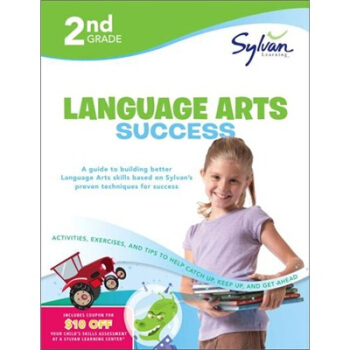
Each Super Workbook is a $39 value for just $18.99! Includes a $10 discount coupon off your child's Skills Assessment at a Sylvan Learning Center.
Second Grade Language Arts Success uses a systematic, age- and grade-appropriate approach to help your child succeed in school. Each section in this 3-in-1 Super Workbook uses activities and practice tools to improve your child's language arts skills and make your child a superstar reader. The engaging and effective exercises in Second Grade Language Arts Success include spelling games and activities, vocabulary puzzles, and reading skill builders.
Why Sylvan Products Work
Sylvan Learning Workbooks won a Honors Award from the National Parenting Publications Awards (NAPPA) as a top book series for children in the elementary-aged category. The NAPPA is the nation' s most comprehensive awards program for children's products and parenting resources, and has been critically reviewing products since 1990. The Award recognizes Sylvan Learning Workbooks as some of the most innovative and useful products geared to parents.
Sylvan's proven system inspires kids to learn and has helped children nationwide catch up, keep up, and get ahead in school. Sylvan has been a trusted partner for parents for thirty years, and has based their supplemental education success on programs developed through a focus on the highest educational standards and detailed research. Sylvan's line of educational products equips families with fun, effective, and grade-appropriate learning tools. Our workbooks and learning kits feature activities, stories, and games to reinforce the skills children need to develop and achieve their academic potential. Students will reap the rewards of improved confidence and a newfound love of learning.
Title: Adventures in Early Literacy: Building Foundational Reading and Writing Skills Target Audience: Parents, educators, and homeschoolers supporting students in the pre-K to early elementary transition (approximately ages 4–7). Format: Comprehensive Workbook (Paperback) --- Book Overview: Laying the Groundwork for Lifelong Learning This engaging workbook is meticulously designed to bridge the critical gap between basic letter recognition and independent reading comprehension. Moving beyond simple rote memorization, Adventures in Early Literacy focuses on developing the cohesive skills necessary for a robust understanding of the English language arts framework. It provides hundreds of structured, age-appropriate activities that foster critical thinking, fine motor development through writing practice, and a genuine enthusiasm for stories and communication. We understand that the journey to literacy is built brick by brick. This volume concentrates on establishing the core linguistic competencies often introduced around kindergarten and reinforced in the initial primary grades. Our approach is holistic, integrating phonological awareness, vocabulary expansion, foundational grammar concepts, and early composition skills within a fun, colorful, and scaffolded learning environment. Section 1: Mastering the Sound System – Phonological Awareness & Phonics Deep Dive The cornerstone of reading success lies in understanding the relationship between sounds (phonemes) and the letters that represent them (graphemes). This section systematically tackles these concepts, ensuring a solid foundation before moving into complex decoding. 1.1 Auditory Discrimination and Rhyme Recognition: Activities here focus purely on listening skills. Students engage with rhyming pairs, alliteration games, and syllable segmentation exercises. This trains the ear to detect the subtle sound shifts crucial for spelling and reading fluency. Examples include matching pictures based on ending sounds, clapping out the syllables in familiar words, and identifying the initial sound in spoken words. 1.2 Letter-Sound Correspondence (Explicit Phonics Instruction): This unit moves from auditory awareness to visual representation. It covers all 26 letters, emphasizing both uppercase and lowercase recognition. The instruction progresses logically: Short Vowels: Intensive drilling on the five short vowel sounds (/a/, /e/, /i/, /o/, /u/) using minimal pairs to highlight differences (e.g., cat vs. cot). Consonant Families: Introducing common consonant sounds, grouped logically (e.g., nasals, stops). CVC Words Mastery: Extensive practice in blending three-letter Consonant-Vowel-Consonant (CVC) words, such as sun, bed, hop. This stage heavily utilizes manipulatives (mental or physical) to segment and blend sounds into whole words. 1.3 Introduction to Blends and Digraphs: Once CVC words are secure, the workbook introduces more complex sound units: Consonant Blends (e.g., bl, st, fr): Students practice hearing and articulating the two distinct sounds within these clusters. Digraphs (e.g., sh, ch, th, wh): Emphasis is placed on understanding that these letter combinations represent a single new sound. This distinction is vital for accurate decoding. Section 2: Building a Vocabulary Toolkit – Word Recognition and Meaning Reading fluently requires recognizing a high volume of words instantly. This section bridges decoding skills with meaningful comprehension by expanding students' working vocabularies. 2.1 Sight Word Immersion (High-Frequency Words): A significant portion of early reading material consists of words that do not follow predictable phonetic rules (e.g., the, said, was). This unit provides structured repetition and visual reinforcement for mastering these essential sight words. The activities move beyond simple flashcard drills, incorporating these words into short sentences and matching exercises. 2.2 Context Clues Introduction: To move beyond word-by-word sounding out, students must learn to use the surrounding text for clues. Simple introduction exercises show children how to use pictures or nearby known words to infer the meaning of an unknown word within a sentence. 2.3 Semantic Mapping and Categorization: Students begin organizing vocabulary conceptually. Worksheets ask them to group related words (e.g., animals, colors, vehicles). This helps build mental networks for faster retrieval and deeper understanding. Section 3: Grammar Fundamentals and Sentence Structure True literacy involves not just reading words but understanding how they function together to convey meaning. This section introduces the basic architecture of the English sentence. 3.1 Nouns and Verbs: The Sentence Skeleton: The initial focus is on identifying the core components of simple sentences: Nouns: Recognizing people, places, and things. Practice involves circling all the nouns in a short paragraph. Verbs: Understanding action words. Students match action words to corresponding pictures. 3.2 Capitalization Rules (The Basics): Clear instruction is given on when and how to use capital letters: The beginning of sentences. The pronoun 'I'. Names of people (initial introduction). 3.3 Punctuation for Clarity: Students learn the function and placement of terminal punctuation: the period (.), the question mark (?), and the exclamation point (!). Exercises require students to correctly punctuate simple statements, questions, and exclamations. Section 4: Early Composition and Creative Expression This final segment transitions learners from recognizing language structures to actively producing them, focusing on clear, simple communication. 4.1 Writing Practice with Scaffolding: Fine motor skills are reinforced through guided handwriting practice, ensuring proper letter formation. Sentences are presented first as tracing activities, then as copywork, and finally as fill-in-the-blank prompts. 4.2 Sentence Construction Workshop: Students move from copying to creating. Prompts are provided to build simple Subject-Verb-Object sentences. For example, given the words "dog," "runs," and "park," the student must correctly arrange them into a coherent sentence. 4.3 Narrative and Descriptive Writing Prompts: The workbook concludes with prompts designed to encourage imaginative but structured writing: Labeling Pictures: Writing descriptive words under an image. “Tell Me About…”: Short answer prompts requiring 2-3 complete, correctly punctuated sentences about a familiar topic (e.g., "Tell me about your favorite toy."). Sequencing Events: Using transition words like first, next, and last to narrate a very simple, familiar sequence (like brushing teeth or making a sandwich). --- Why This Workbook Stands Apart: This resource emphasizes systematic practice and positive reinforcement. Each skill builds logically upon the last, preventing frustration and building confidence. The activities are varied—incorporating matching, circling, filling in blanks, and short composition—to maintain engagement. It serves as an excellent supplementary tool for reinforcing classroom instruction or providing targeted intervention, ensuring that the foundational language arts skills required for future academic success are securely embedded. It is designed to be a robust, standalone resource for reinforcing core literacy skills appropriate for the emerging reader.




這本書帶來的體驗,更像是一場精心策劃的、循序漸進的傢庭學習探險,而不是一場應付瞭事的作業。我記得我們剛開始使用的時候,我有點擔心我女兒(一個對電子産品依賴性較高的孩子)會不會對紙質練習産生抵觸情緒。結果齣乎我的意料,她對這本書的“主題連貫性”錶現齣瞭極大的興趣。這本書的單元主題是圍繞幾個核心概念展開的,比如“我的社區”、“四季的變化”等等,每個主題下都包含瞭詞匯、拼寫、語法和寫作練習,使得學習內容形成瞭一個有機的整體。當我引導她完成關於“四季”的寫作任務時,她可以自然地調動之前學到的關於形容詞的知識來描述“鞦天的顔色”和“鼕天的寒冷”,知識點之間是相互支撐的。最讓我感到欣慰的是,這本書在鼓勵原創錶達方麵做得非常到位。它有一塊專門的區域叫做“自由寫作角”,在那裏,孩子可以不拘泥於任何既定格式,盡情地發揮想象力。即便是塗鴉和一些不成體係的句子,這本書也用非常友好的批注方式給予瞭鼓勵,比如“我喜歡你的想象力!”或者“這個想法很有趣,下次我們試著用更完整的句子錶達它?”這種溫暖的反饋,極大地鞏固瞭她將語言作為錶達工具的信心,而不是僅僅將其視為考試的科目。這使得整個學習過程充滿瞭積極性和探索欲。